What Actually Happens to Your Ramen Noodles in the First Minute of Boiling
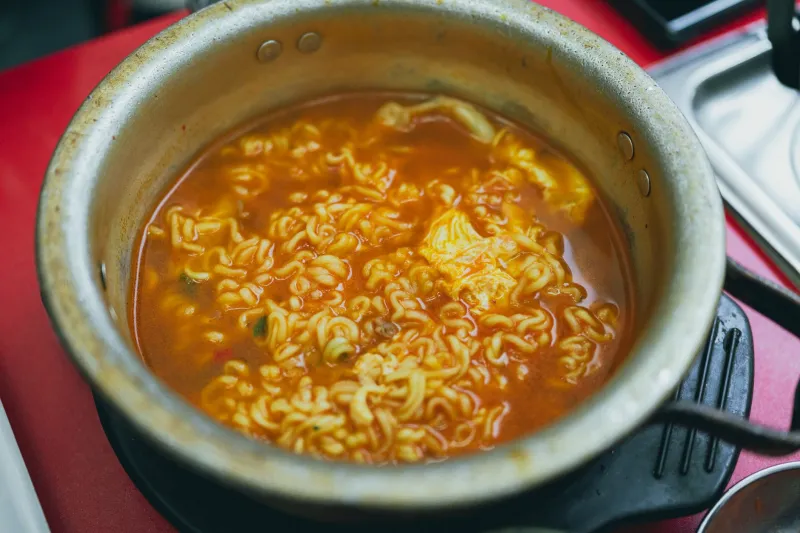
You drop the noodles in, the water bubbles back up, and you kind of just... wait. Maybe you stir once. Maybe you wander off to check on your broth. That first minute of cooking feels like dead time — like nothing particularly interesting is going on.
Spoiler: a tremendous amount is going on.
The sixty seconds after your ramen noodles hit boiling water are, arguably, the most chemically chaotic moment in the entire bowl-building process. Understanding what's actually happening at a molecular level won't just make you a better home cook — it'll completely change how you think about noodle texture, timing, and why that thirty-second window between perfect and overdone is so unforgiving.
Let's slow it way down.
The First Thing That Happens: Water Wants In
The moment a dried or fresh ramen noodle touches boiling water, moisture absorption begins immediately — and aggressively. The outer surface of the noodle is essentially a compressed matrix of wheat starch granules and gluten proteins. That matrix is thirsty.
For dried noodles, this rehydration process is the dominant event in the opening seconds. Water molecules push into the noodle from the outside in, which is why you'll notice the outer layer softening and turning slightly translucent before the center catches up. Fresh noodles — which already contain moisture — skip a chunk of this rehydration phase and move faster toward the texture changes that follow.
Here's the part most people don't think about: the rate of water absorption isn't uniform. It slows as the outer layers hydrate, because saturated starch and swollen gluten create a kind of barrier. This is exactly why you can't just crank up the heat to cook noodles faster — the outside will overcook long before the core reaches the right texture.
Starch Gelatinization: The Transformation You Can See
Around 140–150°F, something called gelatinization kicks off inside the noodle. Starch granules — which are tightly packed, crystalline structures in their raw state — start absorbing water and swelling. As they swell, those crystalline bonds break down, and the granules transition from rigid to soft and gel-like.
This is the process that gives a properly cooked ramen noodle its characteristic chew and slight translucency. It's also what makes the texture change so fast once gelatinization gets rolling. You're not cooking the noodle so much as you're triggering a structural phase change — and like most phase changes, it happens quickly once conditions are right.
Boiling water (212°F at sea level, a little lower if you're in Denver or Salt Lake City) is well above the gelatinization threshold, which means the outer layers of your noodle are already deep into this process while the center is still catching up. That temperature gradient is the entire reason timing precision matters so much.
What Gluten Is Doing While All This Happens
Wheat flour contains two proteins — glutenin and gliadin — that combine with water to form gluten. In ramen noodles, that gluten network is what gives the noodle its elasticity and that satisfying springback when you bite through it.
During cooking, the gluten network doesn't dissolve — it actually firms up through a process called protein denaturation. As the temperature rises, the protein strands lose their flexible structure and set into a more rigid configuration. Think of it like cooking an egg: the proteins go from loose and pliable to firm and set.
The interplay between softening starch and firming gluten is what creates the texture window ramen chefs obsess over. In an undercooked noodle, the starch hasn't fully gelatinized, so the center feels chalky or raw — you're basically biting through starch granules that haven't transformed yet. In an overcooked noodle, the gluten network has broken down too far, the starch has absorbed too much water, and everything turns mushy. The sweet spot — that kata-yude or firm-cooked ideal in Japanese noodle culture — is where gelatinization is complete but the gluten structure is still intact and springy.
What Professional Ramen Chefs Actually Watch For
Talk to any serious ramen chef and they'll tell you they're not really watching the clock — they're watching the noodle.
The visual cues in that first minute are surprisingly readable once you know what to look for. As gelatinization progresses, the noodle surface shifts from opaque to semi-translucent. The noodle also begins to float as internal structure changes affect its density. Some chefs look for the point at which the noodle has just enough give when pressed against the side of the pot — firm resistance with no raw snap.
Another thing experienced cooks monitor is the water itself. Starch released from the noodle surface will slightly cloud the water and can affect the rolling boil. If the water gets too starchy and the boil suppresses significantly, it can actually slow the cooking process — one reason many ramen shops use large-volume pots with very high BTU burners. More water, more thermal mass, more consistent temperature even after the noodles go in.
For home cooks in the US working with standard stovetops, this matters more than you'd think. A small pot with too many noodles will drop in temperature dramatically when you add them, stretching that critical first phase and producing uneven results.
The Alkaline Factor: Why Ramen Noodles Are Different
Here's something that separates ramen noodles from your average pasta: kansui. This alkaline solution — typically a blend of sodium carbonate and potassium carbonate — is added to ramen dough and fundamentally alters how the gluten behaves during cooking.
Kansui raises the pH of the dough, which strengthens the gluten bonds and creates a firmer, more elastic texture. It also causes the Maillard-adjacent reaction that gives many fresh ramen noodles their characteristic yellow tint. During cooking, that alkaline environment means the gluten network in a ramen noodle is more resistant to breakdown than in a neutral-pH pasta — which is part of why ramen noodles hold up in hot broth longer than, say, spaghetti would.
This also means the texture window, while still narrow, is slightly more forgiving in terms of the noodle holding its structure once properly cooked. That said, "slightly more forgiving" doesn't mean you can walk away and check your phone.
Using This Knowledge at Home
You don't need a food science degree to apply any of this. A few practical takeaways:
Use a bigger pot than you think you need. More water means more thermal stability, which means more even cooking from the first second.
Don't crowd the noodles. Noodles stuck together create uneven heat exposure and patchy gelatinization.
Stay close and taste early. Start checking texture 30 seconds before the package says to. The package timing is a guideline, not a guarantee — your altitude, pot size, and burner all factor in.
Watch the noodle, not just the clock. Look for that shift from opaque to slightly translucent. It's a real visual cue, not just chef mysticism.
That first minute is doing the heavy lifting. Give it the attention it deserves, and your bowls will be better for it.