Beyond the Bowl: Learning to Read Your Ramen with Every Sense You've Got
Here's a little experiment. Next time a bowl of ramen lands in front of you, don't pick up your chopsticks right away. Just pause. Breathe. Listen.
Weird advice for a noodle website, maybe. But stick with it for a second, because what you notice in those first few moments before you take a single bite tells you more about what's in that bowl than most people realize. Ramen isn't just food you taste — it's food that communicates, and the cooks who've spent years behind a ramen counter will tell you the same thing. You learn to read a bowl the way you'd read a room.
If you've been eating ramen your whole life and never thought about it this way, welcome to a new level of appreciation. And if you're newer to the ramen world and trying to figure out what separates a truly great bowl from a decent one, this is a pretty good place to start.
The Sound of Something Right
Let's start with something you probably haven't considered: the sound of ramen.
In a well-run ramen shop — whether you're in Tokyo or a serious ramen spot in Chicago or Los Angeles — there's a rhythm to service. And part of that rhythm is audible. Fresh noodles hitting a strainer after being pulled from boiling water have a specific sound: a wet, dense thud that's different from the limp splash of overcooked pasta. When those noodles hit the hot broth in your bowl, there's a subtle sizzle, almost a whisper. It's brief, but it's there.
This matters because it tells you the noodles were cooked to order and served immediately. If there's no sound at all — if the noodles just kind of slip into the broth like they've been sitting in water for a while — that's information too.
At home, you can use this same cue. Cook your noodles until they're just barely done, strain them hard so they're not waterlogged, and listen when they hit your broth. That little sizzle means you got the timing right.
What Your Nose Knows Before Your Mouth Does
The smell of a bowl of ramen is one of its most underrated qualities, and it's one of the first things a serious ramen cook checks before a bowl goes out.
Take tonkotsu, for example. A properly developed tonkotsu broth — one that's been simmering for twelve, sixteen, sometimes even twenty-four hours — has a smell that's rich and almost creamy, with a depth that feels warm even before you taste it. There's a slight funkiness to it, but it's the kind of funky that makes your stomach growl, not your nose wrinkle. If your tonkotsu smells thin or watery, or if the fat smells stale rather than rich, the broth likely hasn't been developed long enough, or it wasn't stored properly.
Shoyu broths have their own signals. A good shoyu ramen should smell like the best version of soy sauce you've ever encountered — layered, slightly sweet, with a background of dashi that reads almost floral. If the soy smell is sharp and one-dimensional, you're probably dealing with a broth where the tare was added too heavily or the base wasn't complex enough to balance it.
Miso ramen is maybe the most forgiving when it comes to smell, but even here, you can tell a lot. Properly incorporated miso has a warm, fermented aroma with a subtle sweetness underneath. If it smells muddy or overly salty upfront, that's a sign the miso was stirred in at the wrong temperature or in the wrong ratio.
None of this requires a culinary degree. You just have to pay attention a few times before you start eating, and your nose will start building a reference library on its own.
The Texture Conversation
Chopsticks are basically diagnostic tools if you use them right.
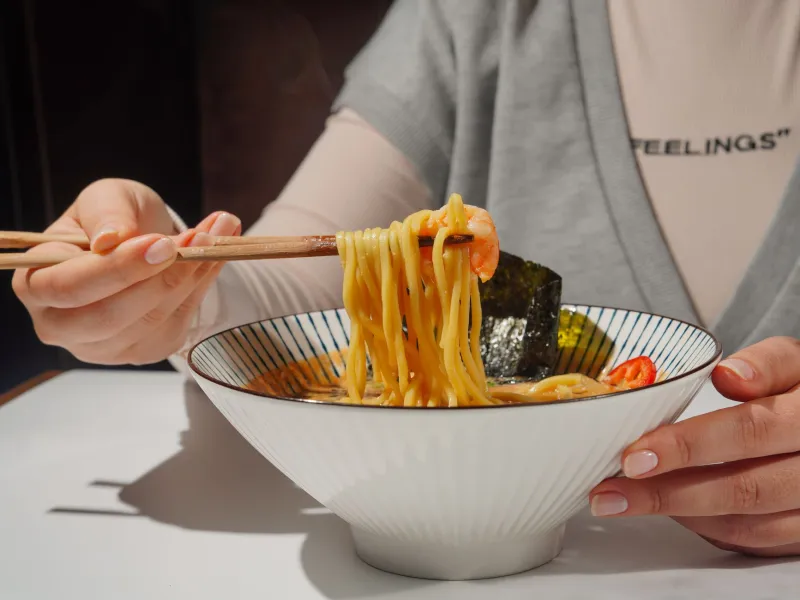
When you lift a nest of noodles from a bowl of ramen, you're getting tactile information about how they were made and how they were cooked. Fresh ramen noodles — the kind made with high-gluten flour and often with an alkaline agent like kansui — have a springiness to them that you can feel. They push back a little. They don't just go limp when you lift them. That resistance is called koshi in Japanese, and it's something ramen makers are genuinely proud of.
If your noodles feel heavy and slack against your chopsticks, they've been overcooked. If they feel stiff and don't bend naturally, they were undercooked or they sat in the broth too long before you got to them — which is why ramen etiquette in Japan leans hard toward eating quickly. The broth keeps cooking your noodles whether you're ready or not.
At home, testing a noodle before you plate by pinching it gently between your fingers can tell you a lot. It should feel dense but pliable — not mushy, not chalky. That pinch test is something ramen cooks do constantly during service, and it's a habit worth picking up.
Reading the Surface
Before you stir anything, look at the top of your broth.
For tonkotsu and other rich, pork-based broths, the surface should have a visible layer of emulsified fat — not a greasy slick, but a milky, integrated shimmer that moves when you tilt the bowl. That emulsification is a sign the broth was boiled hard at some point, breaking the fat into tiny droplets that stay suspended. An under-developed tonkotsu will have a layer of clear oil floating on top rather than that creamy, opaque surface. It's a small visual difference, but once you see it, you'll never stop noticing it.
For lighter broths like shio or shoyu, look for clarity. A well-made shio broth is almost jewel-like — golden, translucent, with a surface that looks almost delicate. Cloudiness in a shio broth usually means something went wrong in the cooking process, often boiling too aggressively or not skimming properly.
Putting It All Together
None of this is about being a snob. Seriously. You don't need to narrate your sensory experience out loud at the ramen counter or make a big show of sniffing your bowl before you eat (your dining companions will thank you for keeping that one internal).
What this is about is getting more out of every bowl you eat. Ramen is one of the most technically demanding comfort foods on the planet, and the people who make it well are communicating something through every element — the sound of service, the smell of the broth, the texture of the noodles, the look of the surface. Once you start picking up on those signals, you'll find that a great bowl of ramen becomes an even richer experience, and a disappointing one teaches you something useful.
Your ramen is always talking. You might as well start listening.